Rapid growth of ALPR camera use raises concerns
PROTECTED CONTENT
If you’re a current subscriber, log in below. If you would like to subscribe, please click the subscribe tab above.
Username and Password Help
Please enter your email and we will send you a password reset link.
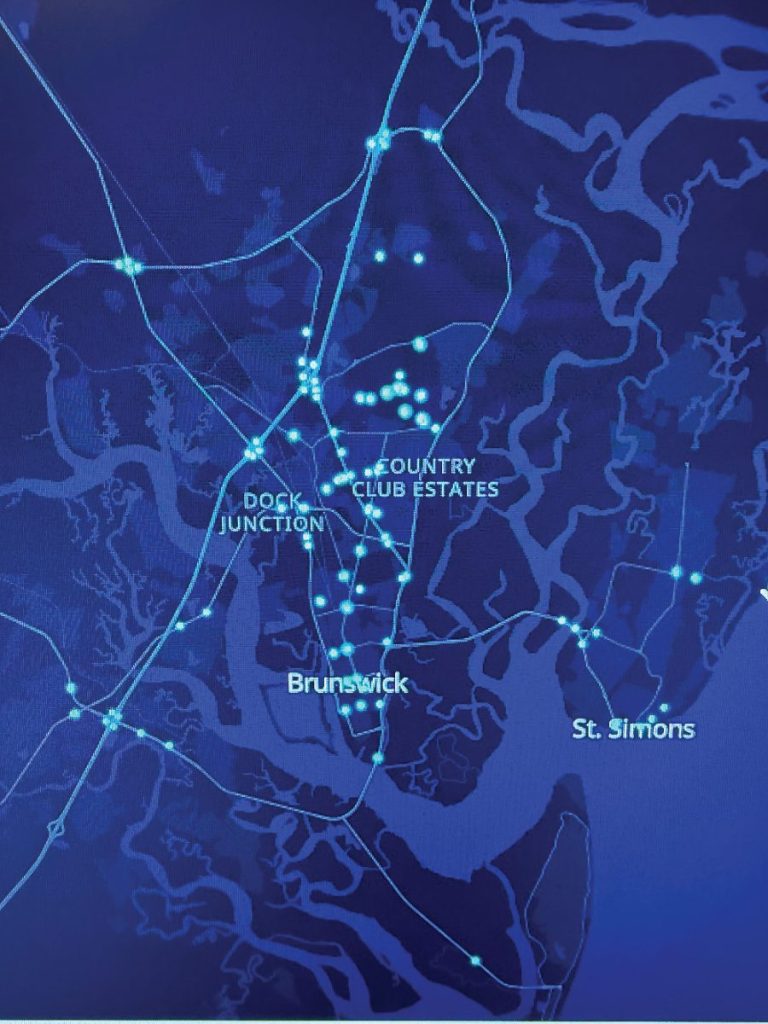
Mapped ALPR Locations in Glynn County Source: Flock Camera Locations
Note: This is the second of a two-part series on automated license plate readers.
As detailed in the first article of this series, the number of active automated license plate readers (ALPR) in use nationwide has reached nearly 145,000.
According to the U.S. Senate Subcommittee on Crime and Counter Terrorism, Atlanta-based Flock Safety “operates more than 120,000 of these cameras in 49 states and logs more than 20 billion vehicle scans a month.”
As home to Flock, Georgia now takes the top spot with the highest number of cameras per capita.
Glynn County has the highest number of cameras per capita among all 159 counties, ranking as the third most surveilled county in the nation.
ALPR technology has played a key role in helping recover stolen vehicles, find hit and run suspects, apprehend kidnappers and human traffickers, and rescue missing persons.
However, rapid growth in the number and use of AI-assisted plate readers has also raised public and elected official concerns about individual privacy, unauthorized access to data, and mistaken identity and wrongful arrests due to partial, incorrect, or outdated information.
The Institute for Justice’s “ALPR Contract Cancellation Database” shows that 277 cities and counties nationwide have cancelled plans, terminated contracts, and deactivated existing cameras in response to such concerns.
The Georgia City of Nelson in Cherokee County ended its contract for automated plate readers in July.
Concern over reader data access is a bipartisan issue, prompting a September 23 hearing by a U.S. Senate subcommittee chaired by Senator Josh Hawley (R-Mo) on “Always Watching: Flock’s Nationwide AI Surveillance Network.”
Testimony by Institute for Justice staff noted that, “as the Supreme Court put it in Carpenter v. United States, location records provide “an intimate window into a person’s life.”
At the same hearing, Arizona Sheriff Ross Teeple testified that he was one of the first in the nation to end his agency’s contract with Flock.
Teeple acknowledged the value of ALPR technology in helping solve crimes, adding that “used properly, point-in-time license plate reading is common-sense law enforcement.”
Despite the benefits, Teeple stated, “I believe the latest camera networks, powered by artificial intelligence and machine learning, are capable of violating our citizens’ Fourth Amendment rights.”
The sheriff noted there are legal requirements for a search warrant to place a physical tracker on a vehicle, but the warrantless mass use of plate readers can collect just as much information.
He asked, “where is the line for camera systems that build an identical, AI-driven map of a citizen’s life?”
Teeple concluded that in pushing the surveillance envelope, “we risk a sweeping judicial correction that could strip away the legitimate, life-saving aspects of ALPR technology entirely.”
Surveillance concerns are amplified by actual cases where incorrect or partial plate entries, character misreads by the cameras, and entries that were never updated or removed have led to innocent drivers being misidentified, wrongfully arrested, and jailed nationwide.
At the September Senate committee hearing, Institute of Justice staff cited the audit findings of the Roseville, California police department. The city reviewed “the 1,427 stolen-vehicle and felony alerts the Flock system sent it over two years and found the cameras had misread the plate in 71 percent of them.”
The failure of law enforcement to temper automated reader technology errors with human judgement has led to dangerous situations for innocent Americans and costly settlements for many communities.
Institute of Justice staff also shared the case of a Sherwood, Arkansas, family in which “a one-letter misread led officers to pull a couple out of their SUV at gunpoint and handcuff them while their one-month-old baby sat in the back seat.”
In her emotional testimony before the U.S. Senate subcommittee, Florida resident Lindsey Isaacs shared disturbing details of her wrongful arrest after Flock camera data was used to label her as a suspect in a fatal hit-and-run.
Isaacs was arrested at her Palm Coast home in April 2026 based on a single Flock camera scan of her black Durango three miles away from the accident scene.
Accident witnesses described a maroon Durango and were able to give a partial tag number.
Investigators relied solely on Flock data when searching for the make and model, while ignoring the fact that Isaacs’ vehicle was undamaged and did not match the color or license plate number from witnesses.
She also had receipts from food and retail stops that proved she was not at the crash scene.
Using only the Flock reader hit, Isaacs was accused of three counts of vehicular homicide and spent 13 days in jail – three in solitary confinement and ten in maximum security. She was denied bond.
She stated that during her wrongful detention, “my mugshot appeared on the news, and I watched as information about me and my case was broadcast publicly.”
Her attorney was able to get the state to reconsider her case by presenting photos of her impounded car that had no damage.
By May 2026, the State ultimately declined to prosecute Isaacs. An investigation eventually led to the arrest of another individual for the fatal crash.
On August 31, Florida Governor Ron DeSantis ordered the removal of all Flock cameras from the state highway system within thirty days.
DeSantis cited concerns over data misuse and privacy concerns, warning, “what we don’t want in the state of Florida is to have a digital AI surveillance state where everything we’re doing is being tracked at all times.”
He also urged the state lawmakers to pass a new law regulating the use of readers in the upcoming legislative session.
Earlier in August, Texas Governor Greg Abbott blocked state agencies from spending money on Flock cameras.
Abbott’s action came after a Flock system audit by the City of Pflugerville, Texas revealed that 459 separate outside agencies had accessed its local camera data almost 1.6 million times over a 179-day period. The city only had agreements with 83 agencies.
According to its website, the city terminated its agreement with Flock and ordered all 28 cameras turned off, disabled access to APLR data, and covered the cameras.
The city ended all ALPR use until it completes new “data governance standards for Secure, Accountable, Fair and Explainable (SAFE) technology use.”
The new policy will “pair accountable human judgment with technological outputs, and ensuring public transparency around, and City Council approval of, high-risk systems like ALPR technology.”
The local school district also terminated a contract and removed its Flock cameras at the discovery of non-partner access to local data.
In Georgia, state leaders continue to welcome automated readers, particularly Flock Safety cameras.
Georgia boasts some of the densest plate reader networks in the country. It ranks third highest – behind only California and Texas – in the total number of documented cameras.
Nearly 270 new cameras were added to the state’s total in just the last thirty days.
In April 2025, Governor Brian Kemp announced the opening of a new 97,000 square foot Flock Safety manufacturing facility in Smyrna.
The Flock Safety investment was supported by state and local economic development incentives.
As part of the deal, the City of Smyrna approved a $5.7 million, ten-year procurement agreement to expand its Flock camera system and add Flock drone technology.
While Georgia and most of its communities have opted to keep and even expand the use of plate readers, high-profile errors and unauthorized use have multiplied statewide.
A Coweta County resident filed a lawsuit on October 8 accusing local officials and staff of illegally using the Flock system to track him in retaliation after he filed a lawsuit against the county on another matter.
Georgia residents have been victims of mistaken identity and arrests based on incorrect data entry, faulty readings by cameras, and officers relying on automated camera hits without independent visual verification.
In September 2026, a DeKalb County student was wrongfully pulled over twice in two days after Flock cameras incorrectly flagged her new car as an uninsured vehicle.
Although the driver provided proof of insurance during both stops, the police gave her a citation based on the Flock alert. It was later determined that the system flagged the tag for purported insurance violations based on an outdated database.
In October 2024, Atlanta doctoral student Ladavius McNair was wrongfully arrested after Flock cameras were used to misidentify him as a suspect in a road rage shooting. McNair spent thirty days in jail before being cleared.
Georgia also has a lengthy list of cases of unauthorized and illegal searches used to track or stalk citizens.
The Islander conducted an extensive review of law enforcement agency statements, media reports, and nonprofit databases.
The search revealed that at least 71 law enforcement personnel in Georgia were fired, demoted, or arrested for unauthorized access to license reader data over just the last four and a half months:
October 15 – Richmond County deputy arrested for unauthorized use of the Flock system.
October 15 – Savannah police officer arrested for sharing her user access with her husband who ran nearly 1,000 searches.
October 9 – Two Baldwin County deputies fired and arrested after an outside review of search requests revealed a pattern of unauthorized searches.
October 7 – Athens-Clarke County police officer fired for tracking his ex-girlfriend.
September 30 – Hall County investigator arrested for unauthorized use of Flock data.
September 14 – Colquitt County deputy fired and criminally charged for Flock system misuse.
September 14 – Emerson police officer charged with unauthorized use at two separate police departments. He was previously with the Acworth Police Department.
September 11 – Information Technology staff with the University of Georgia Police Department disciplined for misuse of the camera system data.
September 10 – Two Peachtree City officers fired and referred to the GBI after misusing the Flock system.
September 9 – Criminal analyst with the Athens-Clarke County Police Department arrested for using Flock data to track his ex-wife.
September 4 – Three Gwinnett officers charged with misuse of license plate reader data.
September 1 – Clayton County sheriff’s officer arrested for misuse of the plate reader system.
September 1 – Corrections officer with the Georgia Department of Corrections arrested for accessing the Flock system for personal use.
August 31 – Two Richmond County deputies arrested for misuse of data.
August 31 – Hahira officer arrested and criminally charged for non-work-related misuse of the Flock system.
August 31 – Tift County deputy demoted for Flock system misuse.
August 26-27 – Three Hall County deputies resigned under investigation for Flock system misuse.
August 26 – Covington police officer arrested for misuse of the Flock system.
August 21 – Four officers of the Savannah Police Department arrested by the GBI for unauthorized searches and misuse for personal tracking. Two civilian staff also fired.
August 21 – Second Hall County investigator fired for Flock misuse.
August 20 – Cherokee County deputy arrested for improper use of Flock data.
August 19 – Hall County investigator fired for Flock misuse.
August 17 – Houston County school resource officer suspended for using Flock data to track family members and coworkers.
August 14 – 911 Director of the Dallas Police Department arrested for illegally accessing Flock data more than 1,000 times.
August 11 – Milledgeville police major arrested and fired for illegal system access for personal use.
August 10 – Three deputies with the Bibb County Sheriff’s Office arrested and dismissed for using Flock data to stalk personal acquaintances.
August 7 – Polk County deputy arrested by the GBI for misuse of Flock camera data.
August 7 – Eight Dekalb County deputies suspended for violation of Flock use policy.
August 4 – Three Coweta officers resigned after an audit uncovered misuse of Flock system.
July 31 – Habersham County deputy arrested for misusing Flock data for personal reasons.
July 30 – Three Richmond County law enforcement staff arrested after unauthorized searches.
July 27 – Ogeechee District Attorney investigator and former Effingham County sheriff’s deputy arrested for personal use of the Flock system for stalking.
July 22 – Dispatcher supervisor with the Conyers Police Department arrested for accessing the flock system for non-law enforcement purposes.
July 17- Three officers with the Fayetteville Police Department arrested for non-law enforcement use of the system.
July 17 – Dekalb County deputy fired and arrested after accessing Flock camera data for unauthorized personal use.
July 10 – Henry County officer fired and charged with accessing data for non-law enforcement purposes.
July 6 – Five Albany police officers arrested after inappropriate access to Flock data.
June 25 – Richmond County staff member arrested after repeated personal tag searches.
June 23 – Three Cherokee County deputies arrested for improper use of Flock camera data.
June 7 – Greene County deputy arrested for using Flock camera data for personal use.
These cases fuel a push to tighten controls over who has access, shorten the data storage period, and improve public transparency.
There are no federal governing statutes on how ALPR data is collected, accessed, secured, retained, or shared. Fewer than half the states have passed laws to regulate this technology.
Georgia is one of 21 states with laws related to the use of automated license plate readers. Passed in 2018, O.C.G.A. § 35-1-22 addresses the length of data retention, access to captured data, and defines the criminal nature of unauthorized access.
The six-year-old Georgia statute allows the longest data retention period at 30 months.
Vermont has the next highest retention window at 18 months. New Hampshire mandates the shortest retention limit at only three minutes.
“…When using the cameras, the police department may hold onto the image of the license plate only for three minutes, unless an arrest, citation, or protective custody order arises or a missing person is found, in which case the record is retained. If the scan does not result in those actions, the license plate image must be deleted.”
Georgia law also states that “Any person who knowingly requests, uses, obtains, or attempts to obtain captured license plate data of a law enforcement agency under false pretenses or for any purpose other than for a law enforcement purpose shall for each such offense, upon conviction thereof, be guilty of a misdemeanor of a high and aggravated nature.”
Georgia code allows law enforcement and other agencies to use a third party for data retention.
Automated reader data in Georgia is not subject to Open Records.
With increasing privacy and data abuse cases nationwide, Flock Safety announced changes to its platform this August.
Starting January 1, 2027, Flocks system’s default data retention period will be shortened from thirty days to only seven days.
Data can only be retained longer if it is tied to a specific case number.
Actual case codes will be required for searches, making it harder to conduct unauthorized searches.
Flock also states its optional monthly audit function will become mandatory to quickly flag suspicious or unusual user search activity. Accounts with unusual activity will be locked for administrative review and clearance.