
Glynn ranks as third most surveilled county in the U.S.
PROTECTED CONTENT
If you’re a current subscriber, log in below. If you would like to subscribe, please click the subscribe tab above.
Username and Password Help
Please enter your email and we will send you a password reset link.
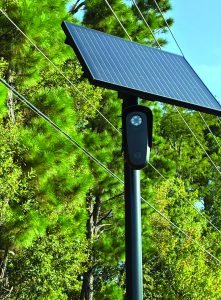
Flock Camera Source: Glynn County PD
By Pamela Permar-Shierling
Note: This is the first of a two-part series on automated license plate readers.
Glynn County is one of the most heavily surveilled counties in the United States.
According to the latest rankings published by Flock Camera Locations, Glynn County ranks third highest in the number of automated license plate readers (ALPR) per capita with 16.4 cameras per 10,000 residents.
This is four times the national per capita of 4.1.
Glynn is behind only Walton County, Florida and Washington County, Tennessee.
Four other Georgia counties rank within the nation’s top fifteen for most cameras per person. Fayette County ranked 9th highest, followed by Fulton at 11th, Troup at 13th, and DeKalb at 15th.
Glynn County has the highest number of cameras per resident among all 159 Georgia counties.
In comparison, neighboring Camden County has a ratio of only 2.5 cameras for every 10,000 residents. McIntosh County has 9.2 cameras per capita, Liberty County has 3.1, Bryan County has 5, and Chatham County has 10.2.
Georgia ranks third highest among states in the total number of documented ALPR cameras at 9,860 – behind only California with 20,557 and Texas with 16,821.
Over the prior thirty days, 266 new cameras were added to the state’s total.
Georgia takes the top spot nationally for the highest number of cameras per capita at 8.7. This is more than double the national per capita of only 4.1 per 10,000 residents.
The Peach State also ranks fourth highest in plate readers per 100 miles of road at 7.7. California leads the nation at 11.6 cameras per 100 road miles followed by Washington, D.C. at 9.9 and Florida at 7.8 cameras.
The Finding Flock website reports more than 10,144 license plate reader cameras in Georgia as of October 15, 2026.
More than 5,700 of the readers are within municipal limits, while over 4,400 are in unincorporated areas.
Atlanta has the most cameras of all Georgia cities at 650.
Map updates by DeFlock show nearly 145,000 active license plate readers nationwide.
License plate readers are fixed cameras attached to poles, streetlights, or utility poles that scan vehicle license plates. Mobile ALPR cameras can be mounted on patrol vehicles.
Captured data is used to obtain, analyze, and store vehicle information such as plate number, location, make, model, color, and unique features such decals, damage, or custom alterations.
The data is intended for use in cases involving stolen vehicles, hit and run accidents, kidnapping and missing person alerts, and other serious crimes.
Atlanta-based Flock Safety dominates the U.S. market for ALPR systems.
More than 90 percent of the cameras in Georgia were manufactured and installed by Flock Safety.
Founded in 2017 by Georgia Tech graduates, the company now employs 1,500 with a total annual revenue of more than $500 million.
Flock Safety serves more than 7,000 law enforcement agencies, including the Glynn County Police Department and the Glynn County Sheriff’s Office.
Flock also has a client base of 5,000 private organizations across the United States that includes college campuses, hospitals, businesses, and residential communities.
In addition to license plate readers, Flock markets video cameras, audio gunshot detection, drones, and investigative software.
Locally, automated license readers are in use by the Glynn County Police Department, the City of Brunswick Police Department, and the Glynn County Sheriff’s Office.
The Glynn County Police Department (GCPD) uses Flock Safety readers with a current network of 85 cameras. The purchase was supported by an $830,000 state grant in 2024.
The Department launched its Flock camera system transparency portal in August of this year.
The portal provides information to the public on the number of plates read, number of hits, and a list of agencies with data sharing agreements. It also provides a link to the Department’s ALPR policies.
According to its portal overview, the GCPD “utilizes retroactive search to solve crimes after they’ve occurred. Additionally, Glynn County Police Department utilizes real time alerting of hotlist vehicles to capture wanted criminals.”
Over the last thirty days (as of October 15), the County system captured 592,955 unique plate reads through its network of 85 cameras.
The reads included nearly 149,000 “hotlist” hits over the 30-day period including listings by the National Crime Information Center (NCIC), Georgia Department of Revenue (DOR), and Amber Alerts.
A “hotlist” is a list of license plates or vehicle descriptions that law enforcement has identified as being associated with a crime, missing person, wanted person, stolen vehicle, or other legitimate law enforcement investigation.
There were 228 user search sessions conducted for the Glynn County Police Department data over the last 30 days.
The portal lists 327 federal, state, and local agencies that currently have access to Glynn County Flock data.
Access includes 195 Georgia county and municipal police departments, 113 sheriff offices, Georgia State Patrol, Georgia Department of Corrections Intelligence Unit, Federal Bureau of Investigation, and Georgia Bureau of Investigation.
Access to Glynn data is also granted to District Attorneys in Gwinnett, Cherokee, Cobb, and Houston Counties, as well as the Georgia Attorney General’s Office.
Nine public university and college police departments and one private institution, Clark Atlanta University, have access.
Other state and local authorities with access include the Georgia Department of Natural Resources, Georgia Office of Commissioner of Insurance and Safety Fire, MARTA, and the Savannah International Airport.
The Nassau County Sheriff’s Office in Florida also has access.
The GCPD portal states that “data is owned by Glynn County Police Department and is never sold to third parties.”
Glynn County policy prohibits use of the system for “immigration enforcement, traffic enforcement, harassment or intimidation, usage based solely on a protected class (i.e. race, sex, religion), and personal use.”
GCPD local access policy, adopted as a standard operating procedure in September 2025, states that “if practicable, the officer should verify an ALPR response through the appropriate independent official law enforcement database before taking enforcement action that is based solely on an ALPR alert.”
The GCPD adds that hotlist hits must be “human verified” prior to any enforcement action.
It also requires “officers to enter a case number, search reason and an offense.” The search access data is “stored indefinitely.”
County policy states, “Partial license plates reported during major crimes should be entered into the ALPR system in an attempt to identify suspect vehicles.”
In compliance with Georgia statute, the Glynn County Police Department policy specifies that “unless otherwise needed for a law enforcement purpose, ALPR data shall be destroyed no later than 30 months after it is collected.”
That is two and half years that data can be retained under current Georgia statute.
Flock Safety previously recommended customers use a thirty-day default retention for data not needed for a specific law enforcement purpose.
Flock recently shortened that default window to seven days in response to abuse of data privacy.
GCPD policy includes penalties for unauthorized use or misuse of Flock system data, quoting Georgia statute language that, “Any person who knowingly requests, uses, obtains, or attempts to obtain captured license plate data from a law enforcement agency under false pretenses or for any purpose other than a law enforcement purpose shall be guilty, upon conviction, of a misdemeanor of a high and aggravated nature for each offense.”
Flock technology also allows clients the option of creating “Safe Vehicle Lists.” These lists are made up of specific license plate numbers that must be entered by authorized users as exempt from reader scans.
Any tag included in this list is automatically bypassed by the ALPR cameras and data is not collected. These lists have drawn scrutiny in communities that have created them.
Glynn County Police Chief Bryan Sipe stated the GCPD does not maintain such a list.
The Glynn County Sheriff’s Office (GCSO) maintains a network of eight Flock readers.
These cameras primarily enhance security at the Sheriff’s Complex that includes the County Detention Center. The readers also support GCSO statutory duties of felony warrant service, civil processes, sex offender tracking, and courthouse security.
Detailed 30-day data from the GCSO was requested. No response was received prior to this article.
GCSO is in the process of building its transparency portal.
In earlier statements, the GCSO emphasizes that its “Flock system does not collect personal identity records, use facial recognition, track mobile devices, or monitor vehicle speed for traffic enforcement.”
Their network is restricted to 26 specified users, who are all Certified Peace Officers actively engaged in law enforcement duties. Not all authorized users have equal search or administrative privileges.
GCSO administrative personnel do not have access to the system or its information.
To prevent unauthorized access, GCSO uses the Flock default in which “captured data automatically hard-deletes after 30 days unless it is flagged as evidence in an active criminal investigation.”
The Sheriffs’ Office added it has “two oversight system administrators who check the system weekly. They are also provided with immediate notification of suspect activity on the systems. Our policies explicitly forbid using ALPR systems for personal checks, harassment, monitoring lawful First Amendment activities, or routine speed/traffic enforcement.”
The two GCSO system administrators “regularly review search logs to ensure all queries align with official law enforcement purposes and policy.”
The City of Brunswick Police Department uses Axon’s Fusus system with 57 cameras that were installed in twenty locations throughout the city in July.
The City Commission approved the $1 million project in February 2026 using a state grant.
Axon was founded in 1993. The Scottsdale, Arizona-based company reached a record revenue of $2.8 billion in 2025.
According to its website, Axon supplies law enforcement with “public and private cameras, body-worn cameras, drones, gunshot detection and license plate readers into a unified platform for real-time intelligence.”
Axon offers a line of devices that include tasers, dash and body cameras, drones, cameras and sensors. The company also provides AI-enhanced software for records and digital evidence management, training, and 911 operations.
The City’s Police Department is in the planning stages of setting up a transparency portal.
In response to a request by The Islander, the City provided 30-day data showing 2,701,301 plate reads (period ending October 20, 2026). Staff noted this total may include repeat plate reads from the same vehicle travelling through different camera locations.
The City’s Axon system logged 18,310 “hotlist” hits over the 30-day period and a total of 460 user search sessions.
Plate records are deleted every 30 days from the date captured.
The Department also confirmed it does not maintain a list of exempt vehicles.

Good for us!